Convective Outlook
— Day 4-8
Discussion
All ensemble guidance suites are in broad agreement that the central US ridge will once again build westward in response to the development of a eastern North America long-wave trough during the forecast period. However, significant differences exist within and between ensembles regarding the timing and exact nature of this transition.
At the start of the forecast period, a frontal boundary will be pushing south and west in the wake of a strong short-wave trough that moved across New England in the prior days. The trend over the past 48 hours is for this front to push farther south and west, bringing a continental dry airmass into New England and portions of the Mid-Atlantic. For example, several days ago ensemble guidance was in good agreement that the front would be draped across the Mid-Atlantic on Friday. Many, but not all, of the recent runs now push the front south into southern Virginia and northern North Carolina. This results in significant uncertainty regarding the potential severe weather environment on Friday (Day 5) across the Mid-Atlantic. For example, the GEFS mean temperature for Washington D.C. is 93F on Friday afternoon, while the EPS mean temperature is 102F. However, both ensembles have dewpoint temperatures in the 50Fs.
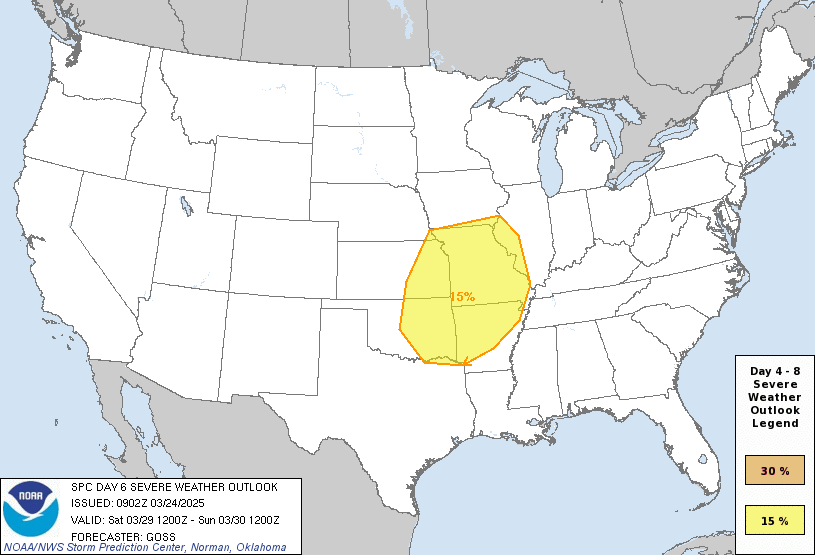
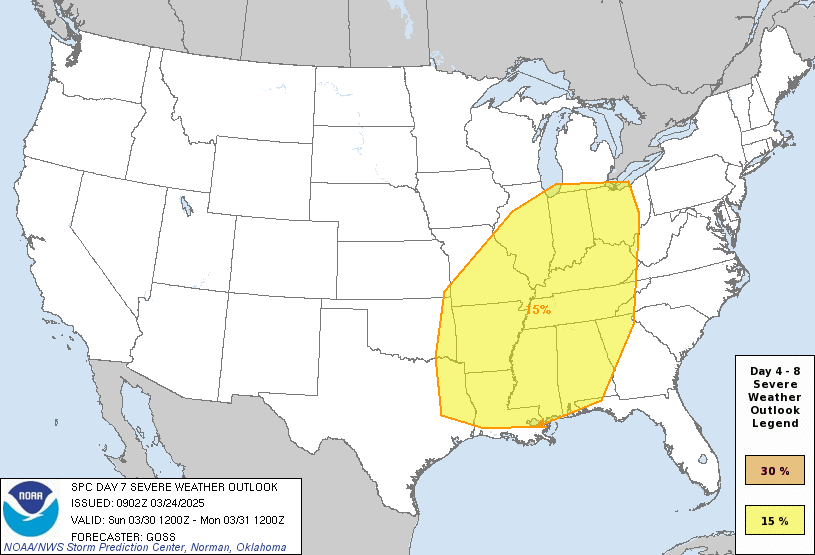
Given the increasing uncertainty as to the location of the surface boundary on Friday and the overall quality of the severe weather environment, unconditional 15% severe probabilities for Friday are removed with this forecast. It is possible that severe probabilities may be reintroduced in later outlooks should it become apparent that the surface boundary washes out earlier than expected and quality low-level moisture is able to return sooner.
That said, the front should begin to dissipate by Saturday in response to a mid-level trough digging southeast across the Great Lakes. This will allow rich boundary-layer moisture to advect northeastward into the Mid-Atlantic and southern New England. This increase in boundary-layer moisture and strong diurnal heating will allow for afternoon MUCAPE values between 1000-2000 J/kg, perhaps locally higher on Saturday and into Sunday.
This unstable and vertically sheared environment will be ripe for thunderstorm/severe thunderstorm development ahead of any digging mid-level trough. However, as alluded to previously, the timing, magnitude, and number of these troughs is highly variable within the ensemble guidance, leading to too little confidence to pinpoint where and when unconditional severe probabilities should be added. As confidence in the timing, track, and strength of these embedded troughs becomes clear, severe probabilities will likely be needed somewhere across the region stretching from the Upper Midwest southeast into the Mid-Atlantic for one or more days.
000
ACUS48 KWNS 130907
SWOD48
SPC AC 130905

Day 4-8 Convective Outlook
NWS Storm Prediction Center Norman OK
0405 AM CDT Mon Jul 13 2026

Valid 161200Z - 211200Z

...DISCUSSION...
All ensemble guidance suites are in broad agreement that the central
US ridge will once again build westward in response to the
development of a eastern North America long-wave trough during the
forecast period. However, significant differences exist within and
between ensembles regarding the timing and exact nature of this
transition.

At the start of the forecast period, a frontal boundary will be
pushing south and west in the wake of a strong short-wave trough
that moved across New England in the prior days. The trend over the
past 48 hours is for this front to push farther south and west,
bringing a continental dry airmass into New England and portions of
the Mid-Atlantic. For example, several days ago ensemble guidance
was in good agreement that the front would be draped across the
Mid-Atlantic on Friday. Many, but not all, of the recent runs now
push the front south into southern Virginia and northern North
Carolina. This results in significant uncertainty regarding the
potential severe weather environment on Friday (Day 5) across the
Mid-Atlantic. For example, the GEFS mean temperature for Washington
D.C. is 93F on Friday afternoon, while the EPS mean temperature is
102F. However, both ensembles have dewpoint temperatures in the
50Fs.

Given the increasing uncertainty as to the location of the surface
boundary on Friday and the overall quality of the severe weather
environment, unconditional 15% severe probabilities for Friday are
removed with this forecast. It is possible that severe probabilities
may be reintroduced in later outlooks should it become apparent that
the surface boundary washes out earlier than expected and quality
low-level moisture is able to return sooner.

That said, the front should begin to dissipate by Saturday in
response to a mid-level trough digging southeast across the Great
Lakes. This will allow rich boundary-layer moisture to advect
northeastward into the Mid-Atlantic and southern New England. This
increase in boundary-layer moisture and strong diurnal heating will
allow for afternoon MUCAPE values between 1000-2000 J/kg, perhaps
locally higher on Saturday and into Sunday.

This unstable and vertically sheared environment will be ripe for
thunderstorm/severe thunderstorm development ahead of any digging
mid-level trough. However, as alluded to previously, the timing,
magnitude, and number of these troughs is highly variable within the
ensemble guidance, leading to too little confidence to pinpoint
where and when unconditional severe probabilities should be added.
As confidence in the timing, track, and strength of these embedded
troughs becomes clear, severe probabilities will likely be needed
somewhere across the region stretching from the Upper Midwest
southeast into the Mid-Atlantic for one or more days.

..Marsh.. 07/13/2026